I still remember the first time my sewing machine got stucked. Once, I decided to stitch a top. Then, suddenly, I heard a sharp sound from the machine- ‘cluck.’ I was so miserable because the machine was jammed.
My mom checked the needle, bobbins, thread guides, and wheel. The needle thread was the culprit. I chose a bigger thread size than required in hurry. And, it was stuck. Mom gently pulled off the thread and replaced it with a thinner one. After that, that machine ran smoothly like butter!!
Likewise, a sewing machine can get stuck for any reason. It may be an incorrect tension setting or improper threading. Many beginners loose time in finding the issue and solving it.
If you are also in a dilemma of ‘Why is my sewing machine jamming again and again?’, I am your help. It’s really easy to solve these issues once with right guidance. That is why, I have given my personal tips and hacks in this guide.
So, let’s get started and clear the hurdles!
10 Common Causes Behind the Jamming Of A Sewing Machine:
1. Wrong Threading:
This is the most common mistake anyone can do. Sometimes, you may thread the sewing machine with the foot up. And, the thread is not present between the tension discs. Or, it may miss the take-up lever.
All these things cause thread tangling, which we commonly call ‘bird’s nest’. And the machine gets jammed.
Solution:
Remove the thread completely. Rethread the top thread through all thread guides.
Ensure that the top thread is between the tension discs.
2. Bobbin Problems:
Bobbin is the heart of strong stitches. Here’s what can happen.
- We may insert the bobbin in the opposite direction. Or it may not produce a ‘clicking’ sound after inserting in the bobbin area.
- Bobbin may get winded unevenly.
- Bobbin may not be caught in the tension spring.
Solution:
- Remove and reinsert the bobbin in the correct direction. It should be in a counter-clockwise direction and show a ‘P’-shape.
- Ensure that the bobbin is wound properly and caught in the tension spring.
3. Loose Upper Tension:
The top thread may get pulled excessively due to loose upper tension. It tangles thread and jams the machine.
Solution:
We have to increase the upper tension setting to avoid this tangling. I usually set it to 3-5, which is in the middle range.
4. Thread And Lint Build Up:
The bobbin case area gets clogged over time with dust, loose thread ends, or lint. It jams the bobbin. Hence, the machine may not give proper lower stitches.
Solution:
Remove the needle plate. Then you can access the bobbin case.
Remove thread ends or lint debris from the bobbin case using a small brush or mini vacuum. Wipe that area using a small cotton swab or cloth.
Re-insert the bobbin and needle plate, and try stitching the fabric again.
5. Sewing Slippery Fabrics Without Tissue Paper Layers:
I was sewing a silk Tunic for my daughter’s 10th birthday party. That fabric was original Tussar silk. It was way too slippery. I ended up jamming my machine. Why? Because I forgot to sew it between layers of tissue paper.
What happened? My machine’s feed dog grabbed that expensive fabric. As a result, my machine was stuck. Somehow, I was able to remove that fabric gently. It took me 15-20 minutes. Have you ever experienced this, too?
Solution:
Slippery fabrics like silk, satin, velvet, etc., may require extra care when sewing. Always sew such fabric between layers of tissue paper. In this way, the feed dog will not grab into fabric or thread.
I prefer using white tissues mostly. Colored tissues or papers may not be suitable as they give a tie-dye effect on fabric.
6. Thin Needle May Bend:
This happens with beginners most of the time. Thin needles can bend easily, too. It ends up jamming our machine.
Solution:
Always hold the silk fabric tightly. Keep one hand in front of the thin needle and the other behind. It avoids excess stress on the needle. You get smooth and regular stitches.
7. Feeds Dog’s Don’t Engage:
If you do not replace or repair feed dogs for a long time, they may cause issues. Such feed dogs do not pull or push the fabric as expected. They end up clogging the fabric in the machine.
Solution:
Check the condition of your feed dogs regularly. Position them at the right place.
Replace worn-out, old, or damaged feed dogs.
Never pull the stuck fabric forcefully- you might end up tearing it.
8. Layers of Fabrics Sewn At Once:
Thick fabrics like denim, jute, or cargo may break a thin needle when sewing. So, we use thick needles. But, doing this may also jam the machine if you sew many layers of such fabric, especially at seams. Feels frustrating when thick needles designed for thick fabrics don’t work, right?
Don’t worry, I have a solution for you!
Solution:
Trim the leftover portion of layers as much as possible after sewing the seam. This eases the sewing for the seam with the second line of stitches.
You can also flatten these fabric layers using a hammer. So, their bulkiness reduces.
Sometimes, thick needles can get stuck in between these layers and the bobbin thread. I use needle lubricant to smooth the needle action.
8. Incorrect Needle Size:
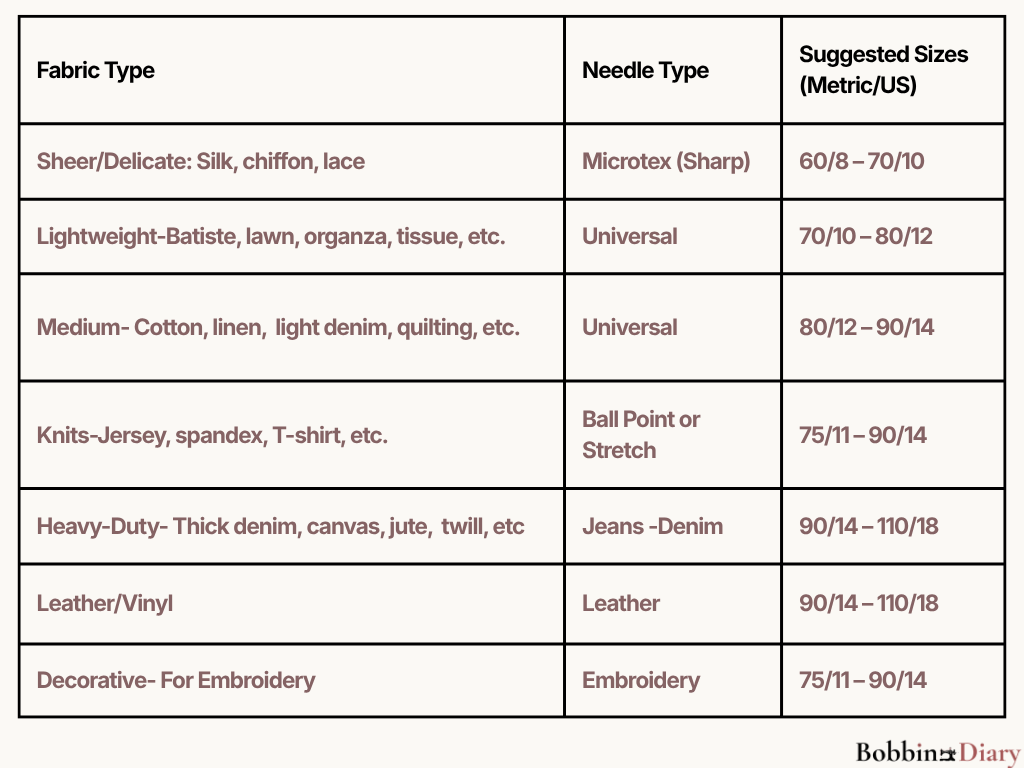
We must know when to use a specific needle for a certain type of fabric. Otherwise, the needle may bend, break, or get stuck in the machine.
Thick fabrics require large needles. You can refer to this table to avoid sewing machine jamming due to an incorrect needle:
9. Burrs:
Sometimes, the thread path gets burrs. It happens mostly near the hook. These burrs block the thread, and the sewing process gets stuck.
Solution:
I use fine sandpaper and small brushes to remove these burrs. Just rub this paper on the thread guides whenever possible. Gently pull off the burrs with tweezers.
10. Oil Issues:
This happens mostly with old machines if not serviced regularly. My 35-year-old Usha machine was stuck due to the same reason. In the hustle and bustle of work, I was hardly getting time to use this machine. Soon, dirt
In such machines, the previously loaded oil droplets dry with time. They become sticky/ greasy due to entrapped dust and dirt. The machine parts do not work smoothly. And the machine’s parts, like the bobbin, needle bar, wheel, etc., stuck more often.
Solution:
Take a few drops of rubbing alcohol on a clean cotton swab. Clean the machine parts to remove greasy dust. If any part is rusted, you can apply WD40 on it.
Let the alcohol dry on all wiped parts.
Oil the machine properly again using new oil. Keep the machine rested for the next 12-24 hrs. The oil gets soaked during this period. Try sewing after that. It will run as smoothly!
Don’t forget to apply oil on the hooks, sliders, needle bar, bobbin case, and under the bobbin (in a drop-in bobbin sewing machine).
Key Takeaways:
It’s okay if any part of your machine gets stuck a few times. The first step to remember is: Not to be afraid.
Try using the hacks I have suggested. I have explained all possible reasons why a sewing machine can get jammed. If the problem does not resolve, read the machine’s manual. Look for any specific cautions they have suggested for that brand’s machine. If the problem is still not solved, take it to the professional repair center.
Let me know which solution helped you solve your machine’s jamming issues in the comments below.
Till then, keep going!
FAQs:
1. What Most Commonly Causes Jamming in A Sewing Machine?
A dull, bent, or overused needle or an incorrect bobbin case assembly mostly jams the machine. The best way to tackle this is to replace the needle and remove stray threads from machine parts.
2. Can I Resolve The Jam In My Sewing Machine By Myself?
Yes, anyone can solve the jamming with little guidance. If the problem is major and you are a beginner in sewing, you must take it to a professional to repair it.