One day, my friend Maxine called me to ask about sewing leather. She had a wallet with a torn corner. Her husband gifted her this wallet, so it was really special to her. I said, ‘We will be needing awl Maxy (I call her this out of love!); Come over, I will repair it.’
In the evening, she came with her wallet. We chatted, had tea, and I stitched her wallet! She was so happy to see it stitched back together. Do you know what helped me the most? It was a SEWING AWL!
We need strong tools like sewing awls to pierce through thick leather or canvas. Because a normal sewing needle can’t do that. If you also want to mend one of your loved belongings or learn, this article will help you the most. Today, I am explaining how to use a sewing awl.
So, keep reading ahead!
Why Stitching With A Sewing Awl Is Better?
As I said before, sewing awls can stitch leather goods or thick canvas fabric. The pressor foot, lever, and special needle move up and down in coordination to pierce through such thick material.
You can sew, punch holes, or hold fabric with this tool. It is almost similar to a small screwdriver, but with a sharp tip.
What‘s A Sewing Awl?
It has a wooden handle, a straight shank, and a sharp tip. It comes in different lengths, ranging from 120 mm to 150 mm.
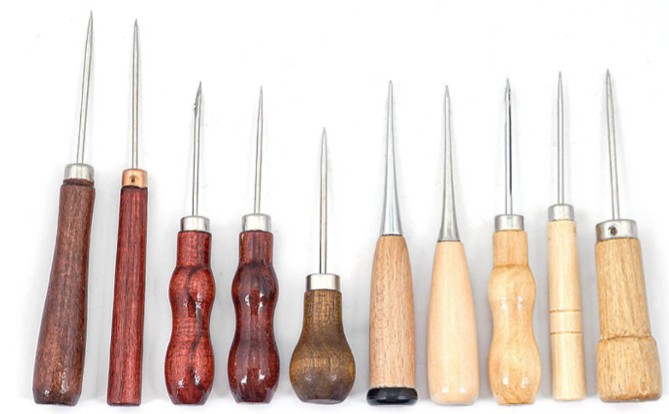
There were no sewing machines in older times. Sewists and seamstresses used tailor’s awls to sew thick fabrics. The leathermen used awls to manually craft the most stunning leather bags, knife covers, belts, shoes, etc.
Most of the manual sewing awls have two types of needles:
- Bent
- Straight
All awls need waxed threads, so they can easily pass through holes. These threads mostly have colours such as: black, brown, dark brown, grey, dark grey, light khaki, khaki, dark khaki, or apricot. Such colored stitches really suit thick denim or leather materials.
1. Traditional Sewing Awl:

When I came to America after my marriage, I brought my sewing kit and a machine with me. In this homely treasure, I also carried my granny’s awl. She used this tiny tool to guide fabric, rip out stitches, etc.
Here’s How I Use Sewing Awls In My Stitching Practice:
1. Used Instead Of a Seam Ripper To Remove Fabric Stitches:
Let’s assume you are sewing a quilt, and your machine mistakenly adds a skipped stitch on the fabric.
Or, you want to rip the seams, but you don’t have a seam ripper?
What will you do?
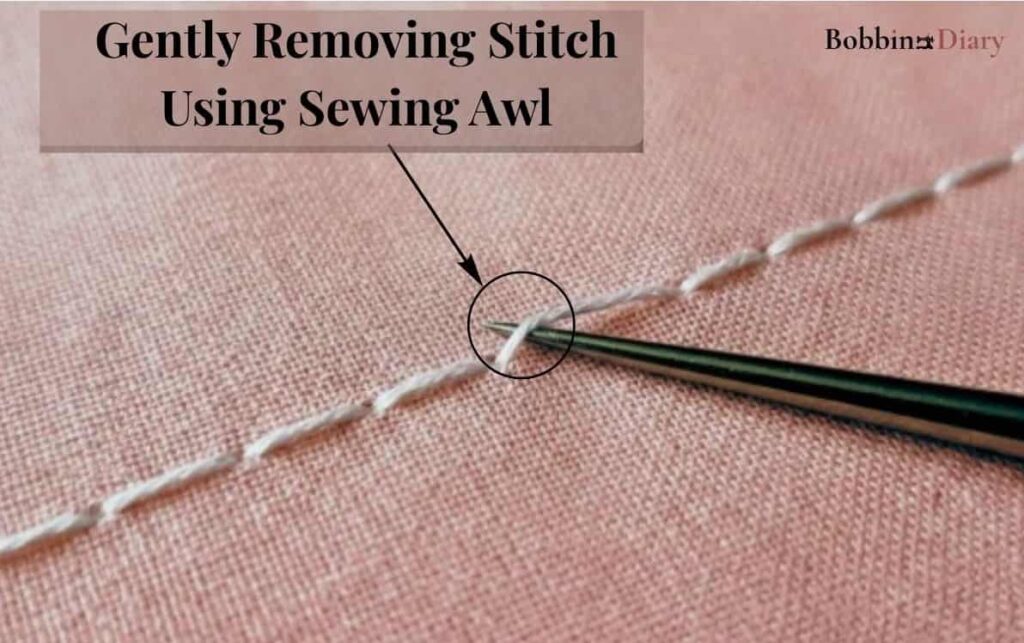
In such situations, I use a sewing awl to remove those stitches. Its pointy tip helps to gently remove the stitched threads without damaging the fabric. It helps when I sew long fabrics like quilts, kids’ blankets, etc.
2. To Catch Thread Under Sewing Machine Needle:
These awls can efficiently catch the thread under the needle plate. Just insert the tip of this tool under the needle plate, move it, and try to grab the thread ends.
This approach is much safer than using your fingers to locate the thread ends. Because our fingers can get really close to needles, oftentimes, which can lead to injuries.
3. Making Holes In Clothes To Attach Buttons:
Many times, we need to attach buttons to jeans, denim shirts, woolen sweaters, cargo pants, or skirts. Poking such thick clothes with a regular sewing needle is a tough task. But a sewing awl can make this happen.
Just hold the fabric where you want to make a hole. Keep the awl’s tip on that point. And, apply a gentle pressure to pierce through the fabric.

4. Using To Hold Two-Layered Fabric While Stitching:
Stitching two-layered fabric is more tedious than stitching single fabric. Why? Because we have to ensure the top thread catches both the lower fabric and the bobbin thread catches the upper fabric.
Many beginners make a huge mistake by pressing their fingers on this fabric closer to the needle. Instead, you can use the tip of an awl to hold the fabric when it comes closer to the needle.
5. Using To Mark Dart Points On Fabric:
You can even use the head of a tailor’s awl to pierce through the main points of darts. In this way, you don’t need to pick the paper again and again to check if you have marked the right point.
Just place the paper on the fabric.
Gently push the awl on the marks of the paper.
After all the markings, lift the paper and check both fabrics for the marks. I am sure they got them!

Now, one might say- we can use a needle instead of an awl to make darting marks.
In my opinion, awls are much more efficient than needles for this task. The tip of the awl is so strong and sharp that it can pierce through any thick or multi-layered fabric.
6. Using Pin Head To Remove Pins While Stitching:
Let’s say you are sewing a tiny cloth. It will have a small stitching area where a normal person’s fingers cannot comfortably reach.
Using the awl head, remove each pin as it comes close to the needle, and also hold the fabric layers there. Its long shank keeps your fingers away from the moving needle.
This technique is best for stitching clothes with a very small seam allowance.
7. For Guiding Fabric Under Sewing Machine’s Needle:
Let me tell you which mistake beginning tailors make the most:
Many beginners use pins or the tips of scissors to guide the fabric under the sewing machine needle. TBH- I did it too!

One day, my mother saw me guiding fabric that way. She suggested that I use an awl instead. What a relief that was!!
Using an awl for that task was easier than pins or scissor heads. This worked especially for thick seams and heavy fabrics.
2. Using Quick Sewing Awl:
You can easily get this awl kit from a local store or Amazon. I got mine from Walmart.

This awl set contains: Screw drivers, needles, base cover, coils to loop threads, awl, waxed thread, etc.
If you need firm lock stitches for sewing heavy materials like leather, canvas, or jute, this awl set can help you the most!
How To Thread A Quick Sewing Awl?
Threading the needle in this awl is easy if you follow the right steps!

- First, turn the screw fixing head away, and take out the needle.
- Remove the base cover using the small screwdriver.
- Choose the right colored waxed thread.
- Wind the chosen thread through the coil.
- Then, wind it through the hole of the same coil.
- Pass the thread through the hole of the main part of the sewing awl.
- Wind the lead pin and pull the thread along the slot.
- Install the needle and go to the screw fixing head.
- Finally, thread through the hole of the needle, and your awl is ready to use!
How To Use A Quick Sewing Awl?
1. Pierce the fabric using this awl.
2. Pass the thread backwards to create a loop on the backside.
3. Pass the loose end through the loop that you created previously.
4. Gently, pull the needle back again. Pull it to tighten the lock stitch.
5. Continue sewing these stitches as much as you need on the fabric.
6. At the final stitch, take the needle out.
7. Create a loop and gently pull the thread. Tie it to form a secure knot underneath the fabric.
Key Takeaways:
Whether it is leather, jute, canvas, or any other thick material, these awls always perform best for strong lock stitches.
You can pull off strangled thread ends from stitches or even make holes in thick jeans fabric with their help. Quick awls like speedy stitchers are way better when you want to repair fabric.
Their pointy ends are perfect for making dart points on fabric. Also, they can hold the seam firmly when the fabric reaches the needle bar.
One tool, many benefits! What else does a stitcher need!!
What are your favorite hacks for using sewing awls? Do let me know in the comments.
FAQs:
What Are The Applications Of Using Sewing Awls?
Apart from sewing clothes, you can use these awls for various things, like:
- Sewing and repairing leather belts, bags, wallets, etc.
- Repairing and mending canvas bags, shoes, sail fabric, etc.
- Mending sofa covers, car cushions, plush toys, and chair fabric.