When I was a kid, I used to think that a sewing machine needed only one needle for all kinds of stitching tasks. But, it’s not like that, right? Sooner, my mom cleared my confusion.
Each fabric has different stitching needs. To fulfil these needs, we need to use different needles. For example, you cannot use a ballpoint needle to sew leather. It will break on long-term use.
To understand the sewing needles, I have written this in depth article. I have also explained thier types and sizes.
Let us move ahead and learn about them:
10 Types Of Sewing Machine Needles:
1. Universal Needle:
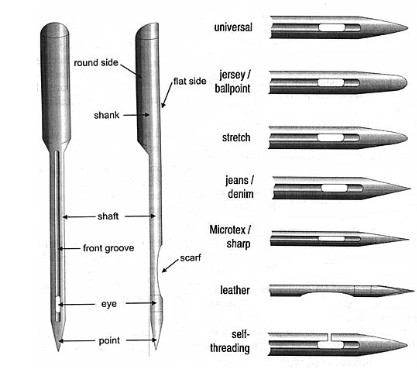
This all-purpose needle is useful for all domestic sewing machines. We can stitch woven and knitted fabrics using it. Beginners can use these needles very easily.
When I started, I used to practice stitching using Singer’s universal needles. I find them very user-friendly and reliable.
This needle has a flat face on its shank and a rounded point. It ensures that we insert this needle correctly. The round point can stitch through multiple layers without damaging the knits.
Normally, I use polyester and cotton threads with these needles.
2. Ball-point Needle:

It is also popular as the ‘jersey needle.’ It is used to add stitches to fabric having knit, cotton knit, interlock, or double knit.
As its name says, a ball-point needle has a rounded tip. This tip pushes the weaved out of the way rather than cutting it while stitching.
In this way, fabric is saved from unnecessary damage while sewing.
3. Embroidery Needle:
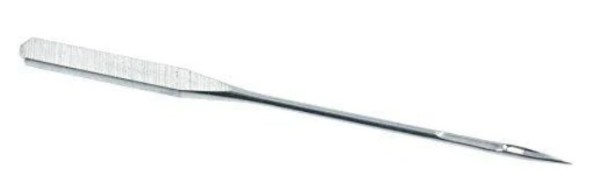
This needle has a wide eye and a deep groove (scarf). I use these needles in sizes of 75/11 or 90/14 in my daily routine. They are not too big, not too small. Just perfect for every stitch!
When we stitch at very high speed, the machine needle can cause slight harm to the thread and fabric.
The deep scarf in this needle keeps the fabric away from shredding. Also, the wider eye prevents embroidery threads from fraying.
Embroidery designs can be very dense, oftentimes. A regular needle may struggle to stitch through these layers. Hence, embroidery needles can easily pass through these designs without sagging or snapping the fabric.
4. Quilting Needle:

Hand sewing a quilt may take one or two days. But, machine sewing takes only a few hrs! That’s the magic of these needles.
They have a tapered shaft and a rounded tip. Due to this design, these needles can sew through thick layers of backing and batting in a quilt.

I usually use Schmetz quilting needles of size 75/11, 75/90, and 90/14. They are compatible with other machine models like Singer, Brother, etc.
These needles are perfect for piecing and machine quilting without breaking or bending. Their blunt tip smoothly passes through the quilt’s ‘sandwich’ layers.
(TBH- you can use any quilting needle; it just needs to be right-sized).
5. Denim Needle:

I call it the ‘Jeans needle.’ I use size 16 needles for stitching denim pants, skirts, etc.
These needles have a distinct sharp point and slender eye. So, they stitch through thick fabric like canvas, denim, upholstery, or jute.
No bending, no frustration!
6. Stretch Needle:
As its name suggests, this needle is useful for sewing stretchy fabrics like spandex, Lycra, elastic, etc.

It has a sharp and narrow eye. Its scarf is quite deep. However, its ball-point is medium. This design helps prevent skipped stitches on stretchy fabrics.
If you don’t find a stretch needle, you can also use a jersey needle instead. Let us see what it is in the following section. I prefer using sizes 75/11 and 90/14 stretchy needles for sewing such fabric.
7. Jersey Needle:

Jersey needles are medium ball-point needles. You can sew knitted fabrics such as jersey, cashmere, interlock, etc., using them.
They have slightly wider, blunter eyes than stretch needles. Size 70 needles are ideal for sewing lightweight jersey fabric. However, sizes 90 or 100 are ideal for multi-layer jersey, fleece, or terry fabrics.
8. Microtex Needle:
Want to sew thin fabric like silk, satin, etc?
Micotex needles are perfect for these types of thin fabrics. These sharp needles can stitch through densely woven fabrics. Apart from thin fabric, these needles are used for sewing leather, microfibre, and artificial leather.
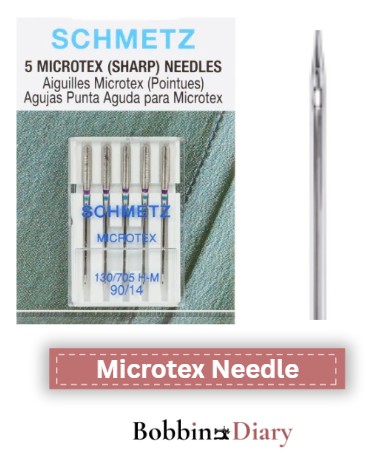
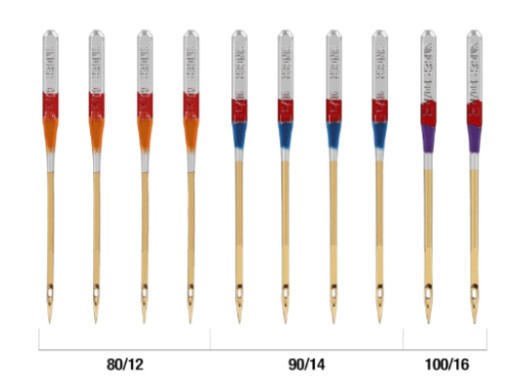
Its tip is so slim that it can stitch straight stitches without damaging the delicate fabric. Micotex needles are available in 60/8 to 90/14 sizes.
For Schmetz microtex needles, you will find a purple band (size 130/705 H-M) over them. I generally use Size 80/12. I find it ideal for stitching a variety of fabrics.
9. Leather Needle:
Leather needs sharper, stronger needles than ballpoint needles. That’s why using a leather needle is very important when working on such materials. You can sew handbags, purses, leather wallets, belts, etc., using these needles.

These needles have a knife-shaped tip. It is also known as the ‘cutting point needle’. So, apart from leather, they can also sew through suede, thick plastic (one we use for raincoats or shed covers), dense canvas, etc.

They have large eyes. So, a thick thread can pass through them.
They are built to sustain pressure under high tension. In this way, you can add tight, strong stitches on thick fabric like leather.
I use 90/14 to 110/18 sizes of these needles. You can choose from these sizes, depending on the leather’s thickness and thread size.
10. Twin (Double) Needle:
Working with stretchy fabrics can be really tricky. Not anymore if you have twin needles.
This needle creates two parallel rows simultaneously. But why two rows?

It helps create neat-looking stitches on fabrics such as knit, jersey, etc. They add straight stitches on the top of the fabric. And add zigzag stitches using the bobbin thread underneath that stretchy fabric.
So, you can add firm stitches on stretchy materials like athletic wear, jersey, swimwear, etc.
I also use these needles for adding topstitching, such as pockets, pleats, tucks, jeans seams, collars, etc.
But have you ever wondered how these twin needles add parallel stitches so smoothly?
We need to use a special pintuck presser foot while using these needles.

This foot helps add straight stitches equally. For decorative stitches, you can even use two different threads. It gives a more pleasing look!

I mostly use a 1.6/70 or 1.6/80-size twin needle for adding narrow stitches. For general sewing, I use a 2.5/80 size needle. For wider stitches, a 6.0/100 needle is perfect!
What Size Sewing Machine Needle Do You Need?
Each sewing needle has a specific size. But, how to measure it? And, how to know which needle size is ideal for the given fabric?
Always remember this:
The diameter of a needle determines its size.
The smaller the size number, the tinier/ finer the needle. E.g., a 70-size needle has a 0.7 mm diameter.
Let us see popular needle sizes and fabrics suitable for them:

My Two Cents:
Using the right-sized needle for a specific type of fabric is very important for your sewing project. For thinner fabric, you need a small-sized needle and vice versa. Stretchy fabrics need twin or stretch needles. Leather needs leather needles. You can use embroidery needles for adding delicate designs.
However, Universal needles are best for stitching all kinds of fabrics. They are best for beginners. I hope this guide on sewing machine needles has given you helpful insights for your sewing practice. Just get the right needle and fabric, and keep practicing.
I have made this blog to help beginners in their tailoring journey. If you need any more help with sewing needles or any other topics, feel free to reach out to me via email.
FAQs:
1. Why Do Sewing Machine Needles Break?
If you use a small needle on a thick fabric, it will definitely break. Hence, using them on suitable fabric is very necessary. If you do not replace the needles for a long time, they can break due to overuse.
Also, if you don’t install them properly or pull the fabric too harshly when sewing, that needle can break. If you use the zigzag stitch setting on a straight-stitch plate, the needle can break.
2. When Should I Change My Sewing Machine Needle?
Each sewing machine needle must be replaced after 6-8 hours of sewing. You can change them before starting a new sewing project.
If you observe that your needle has bent or become dull while sewing, you must change it immediately.