When I enrolled in the tailoring class, I had a project on researching the evolution of sewing machines. Oh, that was the most wonderful part of my study. I have been amazed by sewing machines since childhood. I referenced old books in the library, asked my seniors, and also took help from local tailors to create a fine project. My teachers really loved it!
Most people know machines from brands like Singer, Juki, Bernette, or Brother. But their history unveils more than that!! Who invented them? When did it all begin? Many people in the sewing community frequently ask these questions. If you also have similar questions, I am here to guide you.
In this article, we will explore the rich history of sewing machines. You will get to know their inventors, their timeline, etc. So, let us dive into this and explore the story of these timeless pieces of art!
History of the Sewing Machine:
It all started in Great Britain! This country was witnessing a majestic transition to shift from hand production to machine production industries.
AND, WHAT WAS THE REASON BEHIND IT?- It was intended to reduce the excessive laborious work.
So, did it happen for the sewing and clothing industries?
Yes! Indeed! It was between the 1790s and 1850s!
1. Early Stage (1700s-1800s):
During the 1700s, major textiles and clothes were sewn by hand. This was too much handwork. And, this whole process was slow.
Many ingenious minds thought about getting sewing done with a properly functioning machine. They wanted a machine that is sustainable and useful for years. Here is the story of their attempts:
1755: Charles Fredrick Wiesenthal

Charles Fredrick Wiesenthal, a German-American physician, was the first mover in this invention. He received a British patent (number 701) for inventing a double-pointed needle with an eye at one end.

His work was a ray of hope. He invented something new in this industry.
AND that was: TOOLS THAT NO ONE HAD EVER IMAGINED TO SIMPLIFY SEWING WORK!
1790: Thomas Saint

An Englishman named Thomas Saint invented the first design of a sewing machine in 1790. Originally, he was a cabinetmaker in London. He also patented his sewing machine plans/ blueprints. However, he did not advertise this model as much.
Thomas’s Famous Leather & Canvas Machine:
His sewing machine model had a single-stitch mechanism. This machine was designed to manufacture leather items, including saddles, boots, and bridles. It was also capable of stitching canvas to sew long sails for the ships.
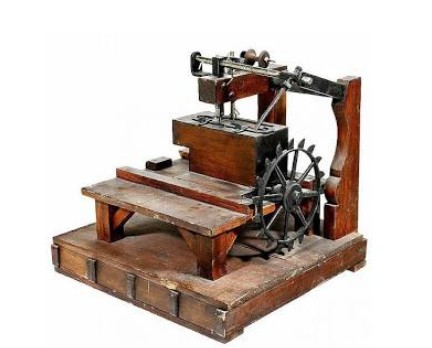
This design included an awl to punch holes, a vertical needle, a looper, and a well-thought-out feeding mechanism to move the leather. Remarkably, the needle had controlled movement up and down while stitching.
Also, the feed mechanism ensured that the fabric was advanced consistently under the needle. It allowed uniform stitches and seams.
His design showcased the actual potential of the mechanical sewing industry and how far it can go.
WELL, IT WAS JUST THE BEGINNING OF AN ERA!
The blueprints of his patent helped to build sewing machines in the clothing industry for decades.
This design was the FIRST SEED of mechanical sewing!
William Newton Wilson’s Patent (1874):
Years later, an entrepreneur named William Newton Wilson found Saint’s patent drawings in 1874. Studying the details in those drawings, he built a replica of Saint’s original design. This replica proved that his (Saint’s) machine really did work!

1804: The Attempt of Stone and Henderson
Two Englishmen, Thomas Stone and James Henderson, tried to build a sewing machine. However, their machine was not successful commercially. They patented the design of the mechanical principle of stitching.
1810: Balthasar Krems
In 1810, Balthasar Krems, a German, invented a machine to sew caps. His machine was operated by foot with a basic wheel feed mechanism. This mechanism helped to sew circular chain stitches.
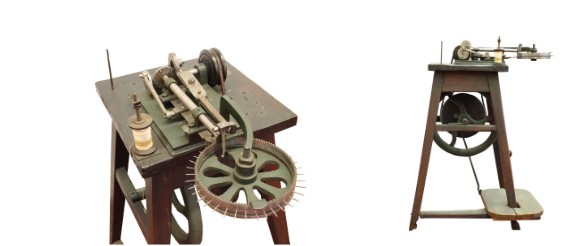
His machine did not work well. So, Krems did not receive a patent for his invention.
1814: Josef Madersperger
An Austrian tailor, Josef Madersperger, started building his first sewing machine in 1807. He spent his life savings on this project. In 1814, he publicly presented his first working machine. His model imitated a human hand in sewing fabrics.
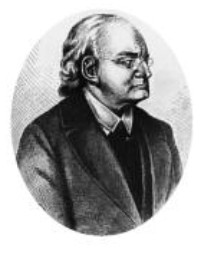
Josef also received financial support from his government. He continued to work on the development of his machine until 1839. Unfortunately, he was unable to improve his sewing machine model. In 1839, he constructed a machine that could sew using chain stitch.

Joseph was out of money for further improvement on his model. He donated this prototype to the Imperial Royal Polytechnical Institute (the predecessor of the TU Wien).
He was not successful in his work, but his ideas paved the way for future innovations in sewing machines.
2. The Beginnings of Sewing Machines: Early 1800s
Inventors from the 17th century laid the foundation of sewing machine concepts. Inventors got inspired to build actual machines after witnessing this period. They understood the concepts of sewing arms, needles, hooks, stitch systems, etc.
The 18th century period actually saw the birth of the first working sewing machine in history!
1830: A Real Breakthrough- Barthelemy Thimonnier:

Barthelemy Thimonnier worked as a tailor in a suburb of Saint-Étienne, France. His wife was an embroidery expert.
He invented the first practical sewing machine that actually worked
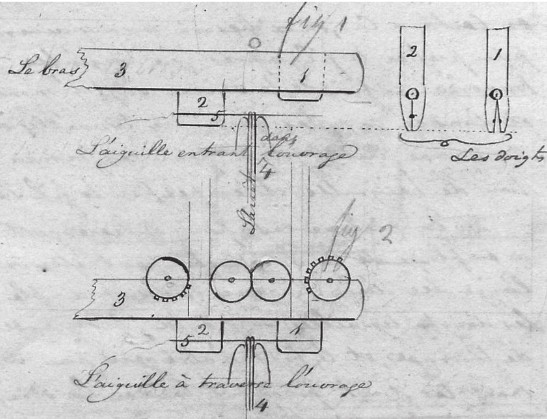
His wooden machine could sew straight seams using a chain stitch method. This machine used a barbed needle passing downward through the cloth. The needle could grab the thread and pull it up to form a loop that was locked by the next loop.
This machine was capable of stitching at around 200 stitches per minute. Its working was quite similar to the tambour embroidery stitch. It allowed faster and more uniform stitching than traditional hand-sewing.

In 1830, Barthelemy signed a contract with Auguste Ferrand, a mining engineer. Mr. Auguste created the requisite drawings of his machine.
In 1830, they received a patent for their machine from the French government along with financial support.
The Riots:
Around 1831, Thimonnier opened his first machine-based clothing manufacturing company at the rue de Sèvres, Paris. Well, it was FIRST in the world too!
This factory had 80 sewing machines. They appointed workers to operate these machines to sew army uniforms.
Unfortunately, a group of 150-200 French tailors attacked this place. They feared unemployment due to the automation of their machines. So, they broke his machines in anger and burned down his factory. Fortunately, he escaped from that incident.
Sadly, Thimonnier’s success was short-lived. He continued improving his machines.
He never stopped believing in his inventions! His idea made people realize that sewing machines could mass-produce cloth!
1833- Walter Hunt: The man who lost the patent
An American mechanic, Walter Hunt, built the first lockstitch sewing machine. Probably, FIRST ONE IN AMERICA too!

Hunt used to invent everyday-use applications and sell their patents to local businessmen at low rates. Just to fulfill his financial needs. But, it was observed that his inventions were widely used in everyday common products in the 20th century.
It was the first modern operating sewing machine. It was invented between 1833 and 1837 at his Amos Street shop, Abingdon Square, Manhattan, New York.
His machine had an eye-point needle, a cloth feeding, a vibrating arm, two threads, and a lockstitch mechanism.
This machine had a needle with an eye and a point on the same end carrying the upper thread. It also had a falling shuttle to pass the lower thread. The curved needle passed through the fabric horizontally. After withdrawing, the needle left a loop. The shuttle passed through this loop to interlock the thread.

Hunt designed this machine very thoughtfully. Yet, its feed was unreliable. It required the machine to be stopped frequently and reset again for the remaining work.
Hunt’s daughter, Caroline, was a professional seamstress. She had many women working in her shop for crafting handmade corsets. Hult believed that patenting a sewing machine might replace the jobs of thousands of seamstresses and tailors. So, he did not patent his machine design until 1834.
After a while, he lost interest in this machine. He sold individual machines without patenting his invention.
1845 Elias Howe- The Man Who Got The Patent Rights:
Elias was from Spencer, Massachusetts. He was a competing inventor of Sir Walter Hunt. Both had intellectual property rights conflicts over the sewing machine.

Howe’s machine had three essential features that are commonly seen in most modern machines:
- a needle with the eye at the point,
- a shuttle operating below the cloth to form the lock stitch, and
- an automatic feeding mechanism.
The working of this machine was the same as Hunt’s machine.

The famous patent battle: The ‘Patent Pool.’
Howe’s friend invested $500 in his project and demanded half the interest in the patent as a return. In 1843, Howe began his work. In 1854, he finished his project and presented a finely working sewing machine with a lockstitch mechanism.
He applied for a patent on this machine in 1846. His machine also had a curved needle and shuttle mechanism.
Later on April 2nd, 1853, Walter Hunt submitted his initial application for his 1834 sewing machine. So, two suitors were in a battle for the same machine.
If we observe the timeline, Hunt designed this machine before Howe. But Howe was able to submit all paperwork before Hunt. As a result, he won the case and received a U.S. patent (no. 4750) for that design.
Howe won because of his right timing and the technicality in paperwork. He also started receiving royalties from Singer and other businessmen for sales of his patented invention.
Even though Walter Hunt lost this court case, the court administration awarded him a public acknowledgement for his invention.
3. The Revolution Era- Mid 1800s:
1850 Allen Wilson and Nathaniel Wheeler:
Allen B. Wilson and Nathaniel Wheeler partnered to start a sewing machine production company named ‘Wheeler & Wilson’.
Wilson was an American journeyman cabinetmaker. He toured the USA during the 1840s, when he had an idea of building a sewing machine (around 1847). In 1849, he completed his prototype and sold it for $200.
Using these funds, he received a patent (US Patent No. 9,041) for his machine’s model in 1850.
But, a unique fact was:
He invented the reciprocating shuttle machine. It was different from other models. This machine inserted two stitches instead of one:
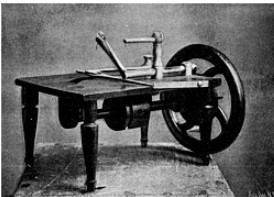
The needle formed a loop with a seam when inserted into the cloth. A shuttle was appointed at both ends. It held a second thread that was later passed through the loop.
A lockstitch was made. The tension on the thread in this machine was increased. This shuttle was movable from the front and back! So, it formed a stitch in these movements. This resulted in firmer stitches than Hunt’s and Howe’s single lockstitch machines.

Wilson replaced the shuttle with a bobbin and a rotary wheel. This machine had four motion feeds (two front and two back). He then added a stationary bobbin and patented this model in 1852. With this advancement, the needle thread was able to lock with the bobbin thread by passing the needle thread loop under the bobbin. It led to lockstitches on fabrics.
He partnered with Mr. Wheeler. It led to formation an enterprise, the Wheeler & Wilson Manufacturing Co. Wheeler helped him expand the production of these machines.
Their company was the biggest and most successful manufacturer of sewing machines in the 1850s-60s. In that period, they sold over 2,000,000 sewing machines!
In 1905, Singer Corporation acquired this company after both of its main owners died.
1851- Isaac Merrit Singer:
Who doesn’t know this name? Isaac Singer is the G.O.A.T of this industry!
Isaac Merritt Singer built these legendary sewing machines. My grandma had one too!
In 1850, he manufactured his first straight-stitch sewing machine at a small machine shop in Boston. This machine was mainly made for general domestic use. He named this machine ‘Standard 1’.
In 1851, he established ‘I.M Singer & Company’ in New York! He incorporated this company with Edward B. Clark, attorney-at-law.

He took a patent for an improved version of his machine. It included a circular feed wheel and a thread controller. The power was transmitted by gear wheels and shafting for continuous sewing.
The added foot treadle, the up-and-down needle movements, and a large base made these machines more useful for home use.

In 1854, Elias Howe sued Singer for using his lockstitch mechanism in his machines. Howe won the lawsuit, and Singer had to pay royalties to him.
These legal battles and their declarations created opportunities for mass production and the affordability of sewing machines for all. In 1910, Singer and Co. demonstrated the first workable electric sewing machine, which totally changed the sewing world!

They started with small shops in Boston in 1850 and in New York in 1853.

Their factories in Elizabethport, NJ, and Clydebank, Scotland, were the leading global manufacturing hubs.
They sold over 262,316 units of their machines by 1876. By 1916, their Clydebank factory was manufacturing 13,000 machines per week on average.
1857 James Gibbs and James Wilcox:
These two men founded the ‘Wilcox and Gibbs Sewing Machine Company’ in London in 1857. They improved existing versions of sewing machines for the betterment.

Gibbs built a single-thread chain-stitch machine for stronger stitches. The head of this machine was ‘G’ shaped. He also added a revolving loop that pulled the right amount of thread up through the material for the next stitch.
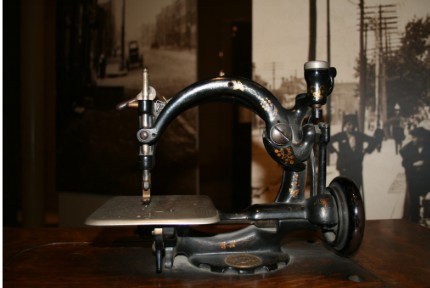
This machine was smaller, lighter, and used half the amount of thread as other models. And, it didn’t have any bobbin.

These machines were useful and unique. But they did not receive enough recognition, like other brands, such as Singer.
1852 George Francis Bradbury:
George Francis Bradbury and Thomas Sugden, both trained mechanics, founded the ‘Bradbury Sewing Machine Company’ in 1852 in Oldham, Lancashire. This company was one of the first companies in Europe to produce sewing machines at a higher rate.
He named this machine: Adjustable Belgravia. It was capable of lockstitch, Pearl stitch, and Cable stitch. I could embroider on both sides of the fabric simultaneously in one to eight colors!
Magnificent, isn’t it?

Not only that, but his machine also had an adjustable cloth presser ring, belt tightener, double quilting gauge with slide, and oil shield! The beautiful lotus design on this mechanical giant was just the cherry on top!
This machine was futuristic! Way ahead of its time!
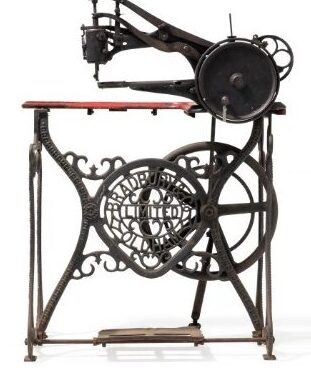
Likewise, Bradbury invented the boot-patcher industrial machine in 1878. It sewed thick boot fabric and harness leather to form a perfect stitch. Many cobblers and shoe companies used this machine at that time!
1873- Helen Blanchard: Origin Of Zig-Zag Machines
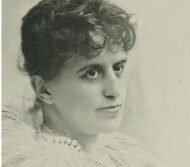
Helen tried to improve sewing machines to save time and energy. Soon, she invented a machine that stitches in a zig-zag pattern.

In 1873, she applied for a patent. AND, HER HARD WORK PAID OFF!!

It was not easy for her to achieve this success at that time. Her machine was capable of doing back-and-forth stitches. It was widely used for sewing buttonholes, sewing stretchable fabrics, and completing seams. These stitches made garments sturdier.
4. The Advancements in Sewing Machines: 1900s and further
90s Era:
The 19th century saw a sudden growth in electric machines, particularly the 1920s. It helped to enhance sewing speed and efficiency for manual operations, which previously required hand cranks or foot-operated treadles.
Older machines were heavy. Singer introduced the popular Featherweight machine in 1933.
Singer sold 3 to 3.5 million Featherweight machines between 1933 and 1968. Such models helped to increase their portability, which was a tedious task before.
Most manufacturing companies shifted from heavy cast-iron frames to lighter aluminum injection-molded frames. These changes made these machines lighter and easier to handle.
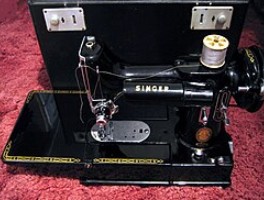
Leading brands like Singer brought interchangeable machine parts and payment plans. It helped middle-class people to afford these machines for domestic use.
In the late 90s, we were introduced to computerized sewing machines. They had modern features such as programmable stitches, LED screens, Wi-Fi connectivity, and advanced embroidery patterns.
21st Century:
The 21st century contributed to the rapid growth of these machines. Now, the machines have AI features such as fabric detection, automatic needle threading, bobbin winding, re-stitching for skipped stitches, etc.

Key Takeaways:
The invention of sewing machines changed the face of the clothing industry! From wooden frames to cast-iron bodies, they saw many changes during the 18th and 19th centuries. Great inventors like Howe, Singer, Hunt, Walter, Madersperger, etc., made this dream possible.
Sewing shifted from manual seamstressing to automatic stitches over the years. Their evolution will continue to grow on!
Who knows, we might have to give only a command to stitch a garment in the future? It is possible with the help of robotics and artificial intelligence.
I hope you loved this detailed guide on the history of sewing machines. If you have any facts to share, feel free to comment below!
FAQs on Sewing Machine History:
1. Which Is The Oldest Sewing Machine?
Barthélemy Thimonnier, a French tailor, invented the world’s first and oldest sewing machine in 1829.
2. Who Has The First Patent For The Sewing Machine?
Elias Howe received the patent for sewing machines on September 9th, 1846.
3. What Was The ‘Patent Pool’ For Sewing Machines?
It was formed in 1856 to end expensive patent disputes. This pool was formed between Singer, Wilson, Wheeler, Elias Howe, Grover, and Baker. The US High Court pooled essential patents from these inventors. This allowed them to license technology rather than litigate. It also helped them to focus on mass production to enhance industry growth.