Have you ever looked at any garment piece so closely?
If you have, you know that a fabric is nothing but a whole bunch of threads woven in a criss-cross pattern.
If not, take a magnifying glass today and look for it! It’s amazing to observe these weaves. You will notice a pattern in them. This pattern is nothing but ‘GRAINLINE’.
Grainline patterns play a major role when you sew fabric. So, if you are also new to this concept, my article on ‘What is grainline in sewing?’ can help you. We will dive into its main types and why it’s important while stitching long pieces of fabric.
So, let us learn more about it.
What’s A Grainline?
It’s basically the thread patterns that make the fabric look even and well-aligned.
It has three main types based on the orientation of the weave. You can notice the same grainline pattern in all the fabric areas of a single outfit.
It’s important because the fabric looks neat when draping fabric layers, topstitching, etc. Well, these patterns do differ. Let us see how in the following section:
3 Types Of Grainline:

1. Lengthwise- Warp
This is a straight grainline. Designers call it the ‘Warp.’
An arrow on the pattern indicates the Warp. This arrow shows the correct direction for placing the pattern on the fabric.
All Lengthwise grains are parallel to the selvedges. This pattern helps to maintain the outfit’s straight shape. This grain is the strongest of all.

You may observe little or no stretch in such fabrics. And, due to its anatomy, this grain runs perpendicular to the ground. Hence, it is found in garments like pants, shirts, etc.
2. Crosswire- Weft:
This grain is perpendicular to the selvedges. Hence, we call it ‘cross-grain.’ Because it is perpendicular, it offers more stretch than the weft (lengthwise grain). You will find it spanning from edge to edge.

Its anatomy makes the fabric flexible and easy to carry. So, this grain is found in moving body parts like shoulders, knees, waist, neck, etc.
But it is slightly weaker than the lengthwise grain
3. Bias- True:
Have you ever observed an evening gown? How elegant its fabric looks! But what is the wonder behind it? It’s the use of a ‘bias-true’ grainline in fabric.
When it comes to stretch and draping, bias grainlines help the most! It runs at a 45-degree angle to warp and weft.

So, the fabric of such grainlines feels more fluid and softer. It is found in body-hugging outfits such as dresses, skirts, crop tops, scarves, sarees (traditional Indian attire), etc.
Why Is Grainline Important In Sewing?

Positions of warp and weft
But why is it so important? Let me tell you why:
- It offers a proper shape and look. If you use warp instead of weft or vice versa, it will decrease the outfit’s overall look.
- Ignoring it can twist the fabric at the waist, sleeves, or shoulder. Overall, the garment may look uneven.
- No matter how experienced you are in stitching, the garment may look weird due to the wrong grainlines.
- Have you ever noticed your T-shirts or tops curling or twisted after washing? It may be due to an incorrect grainline. Such fabrics often lose their original alignment.
- Correct grainlines on the right piece of fabric give a neat, polished, and professional look.
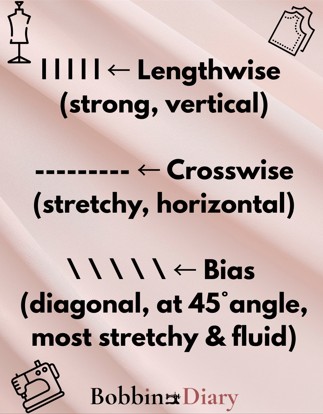
This diagram will help you understand the difference between these three grainlines:
Key Takeaways:
Grainline determines the anatomy of your fabric. If the grainline runs parallel to the selvedge, it indicates the lengthwise- warp grain. It has no stretch.
Crosswire- Weft grainline has threads at 90 degrees to the selvage with good stretch! The final one- bias grainline is perfect for draping fabrics! It can control the outfit’s look while hanging.
Always test these grainlines before cutting the final panel of fabric. It must match another piece. Otherwise, the outfit looks weird or curls after washing. I hope this guide on grainlines of fabrics has given you helpful insights. If you need more help, you can email me! Happy to help you!
FAQs:
1. How To Check If The Fabric Has Lengthwise Grain?
Try stretching the fabric near the selvage. If it remains the same with little or no stretch, it has a lengthwise grain. In fact, cross-wire and bias grainlines have more stretch than lengthwise grainlines.