Do you know Brad Pitt wore Redline selvedge denim in most of his outfits? D. Craig loves Levi’s, Tom Ford, Rag & Bone, etc. brands.

‘The Devil Wears Prada’s fame, Andy, i.e., Anna Hathaway, is also a big selvedge enthusiast. She wears them mostly in her casual outfits. But what’s common in them? Jeans with SELVAGE!!!
TBH, such outfits never go out of trend! But what does it mean?
A selvage is the frayed or tight edge that is visible at the border. Whether it is cotton, linen, silk, or rayon, this tightly woven edge protects the fabric weave from fraying. If you are into sewing, you must know this term. I have elaborated on the actual meaning, uses, and types of selvedge in this guide.
So, let us move ahead and know about it:
What is A Selvage In Fabric?

It is the tightly woven edge of the fabric. The name ‘selvage’ (US English) or ‘selvedge’ (British English stands for a self-finished fabric edge that does not fray.’

It is present on both lengthwise sides of the fabric. Such edges do not require extra finishing like hemming or taping.
6 Types Of Selvadge You Must Know:
1. Plain:

Have you seen a solid color or white band at the edge of the fabric? You will find these edges in denim or cotton fabric. In this selvedge, the weft wraps around the outer edge. Weft turns back to create the edge.
This basic weave prevents fabric from unraveling. It is made using the same yarn as the fabric
2. Tape:

Basket, twill, or plain weaves are used in tape selvedges. These weaves are often combined with heavy and plied yarn to prevent wear and tear.
In the following image, the white strip with a colored red line is taped selvedge.
Hence, it is more durable and stronger than the plain selvedge. It is mostly used in sewing upholstery or heavy-duty fabrics.
Here is how it looks diagrammatically:

This flat band on the edge makes it even stronger and sturdier. It reduces unnecessary stretching and distortion of the main fabric.
3. Split:
Have you ever observed the edges of a towel?
Wide fabrics are woven on two or more sides together. Then they are cut into individual pieces. That’s why they are known as‘split ‘selvedges. In easy words, a narrow width of fabric is woven twice its regular width with two selvedges at the center.

Such selvedges are hemmed or chain-stitched for polished finishing.
The same process is followed in making ribbons, tapes, etc. In this way, you can make multiple fabric panels in less time.
4. Fused:
Some people call it a heat-sealed edge or fabric with heat-cut / heat-finished edges.
For an easy explanation, tell me: have you ever heated a frayed end of a satin ribbon?
If so, you might have noticed that the loose threads melt and stick together when we press them together.
The same process happens while making fused selvedge. I have made a diagram to explain this to you in a better way:

Such fabrics contain thermoplastic thread fibres, such as polypropylene, nylon, etc. These fibres are pressed using a hot mechanical device on the edges of the fabric.
Due to the heat, these special fibres melt and fuse. This process seals the edges. So, you get- no fraying and firmer edges! Such selvages are mostly used in sewing curtains, labels, cloth straps, ribbons, and webbings.
5. Leno:
The warp yarns are twisted around the weft yarns. When these two yarn threads twist and form a cross, this process locks the weft. It forms the leno selvedge.

Leno selvedges are useful in lightweight, loose, and open-weave fabrics.
6. Tucked:
Normally, the weft is cut after it gets woven across the threads. So, we can see a tail (the thread which is left behind).
But in a tucked-in selvedge, the weft thread is tucked back at the following weave. The weft threads do not get cut here.
Since the weft is getting re-tucked, it appears denser and thicker. You may find it in heavy-duty fabrics such as jute and denim. Due to higher durability, it is used in home decor fabrics like curtains, table covers, etc.
Why Does Selvage Matter in Sewing?
1. Avoids Fraying:
Without a selvedge, a fabric would fray immediately.
Selvedges keep the woven threads tucked.
2. Aligns Grains Straight:
All selvedges are straight. It helps you to find the straight grain line and sew your pattern accordingly.
Once, I sewed a top’s sleeves without aligning its pattern with the selvedge. You know what happened?
Initially, it looked okay. But after the first wash, the sleeves started twisting around my arms.
3. Opting Hemming:
I personally prefer this. It not only saves my time but also my efforts.
No zig-zag or overlock stitches on the edges!
When I sew waistbands, inner pockets of pants, or neckline facings, I do not use hemming.
Instead, I use selvedges for sewing these parts. It reduces the bulkiness. I get a more finished look in the garments when I use tucked selvedges.
These edges are much tighter than normal hems. So, I also use them while sewing closures like zipper openings, button bands, cuffs, etc.
4. For Locating Front Side Of Fabric:
Have you ever accidentally sewn any garment upside down? TBH- I did, in my early learning days.
This happens when we don’t pay attention to the selvedge. So, to check the right side of the fabric, here is what you can do:
- Every selvedge has small holes on the border.
- Feel these holes.
- If they are smooth, it means it is the front side.
- If they feel rough, it means it is the back side of the fabric.
- One more way to find it is: Textile companies print their brand name on the edge. These brand-name or logo strips are always present on the front side of the fabric.
Do you know?: Small colored dots or checkers on the selvedges tell the dyes used in that fabric’s weave.

Sometimes, they also have special mentions, like 100% organic, Made in USA, etc.
5. For Decorating:
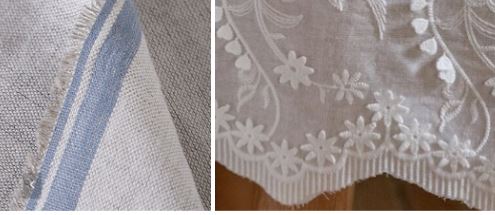
I love boho or minimal decor. And, the fringed fabric helps me a lot in that!
Whether it is a wall hanger or a table cover, the lashes at the edge of the fabric give a subtle touch to the overall look!
Key Takeaways:
This amazing self-edge is very useful if used smartly.
You can avoid fabric puckering, fraying, or unnecessary damage at the edge by using it. Fringed edges of curtains or cloth covers give a chic look to your overall decor.
I feel they are a smart alternative to hemming and seam allowance. So, know selvages in the fabric today and use them properly!
FAQs:
1. How To Identify Selvedge On Woven Fabric?
Woven fabric’s selvages run parallel to the warp. Warp is the longitudinal threads that run across the fabric. The weft thread loops back at the end of each warp in these selvedges.
2. How Does Selvedge Look on Knitted Fabric?
Knitted fabrics have unfinished selvedges. But these edges do not cast or bind off the fabric. They are more structural.
3. How To Find Selvedge On Any Fabric?
It is a finished edge. Like its name says, a kind of ‘self-edge’! It looks tighter than a normal edge. And, it has tiny holes. It gets these holes during its manufacturing process. You may find the brand name, color code dots, or color lines on it.